


' fill='%23fff' stroke='%23707070' d='M0 0h21.6v21.6H0z'/%3e%3c/clipPath%3e%3cclipPath id='c'%3e%3cpath data-name='Rectangle 6531' transform='translate(-6319 -2048)' fill='%23fff' stroke='%23707070' d='M0 0h43.2v21.6H0z'/%3e%3c/clipPath%3e%3cclipPath id='a'%3e%3cpath d='M0 0h21.6v21.6H0z'/%3e%3c/clipPath%3e%3c/defs%3e%3cg data-name='Malaysia -Square' clip-path='url(%23a)'%3e%3cpath fill='%23fff' d='M0 0h21.6v21.6H0z'/%3e%3cg data-name='Mask Group 325' transform='translate(6348 2048)' clip-path='url(%23b)'%3e%3cg data-name='Mask Group 324' transform='translate(-35)' clip-path='url(%23c)'%3e%3cg data-name='Group 21195'%3e%3cpath data-name='Path 14718' d='M-6319-2048h43.2v21.6h-43.2z' fill='%23fff'/%3e%3cpath data-name='Path 14719' d='M-6317.457-2047.229h41.657m0 3.086h-41.657m0 3.086h41.657m0 3.086h-41.657' fill='none' stroke='%23c00' stroke-width='1.543'/%3e%3cpath data-name='Path 14720' d='M-6319-2048h21.6v13.114h-21.6z' fill='%23006'/%3e%3cpath data-name='Path 14721' d='M-6319-2034.886h43.2m0 3.086h-43.2m0 3.086h43.2' fill='none' stroke='%23c00' stroke-width='1.543'/%3e%3c/g%3e%3cpath data-name='Path 14722' d='M-6302.5-2045.686l.344 2.353 1.331-1.967-.714 2.269 2.054-1.2-1.626 1.731 2.372-.19-2.218.858 2.218.858-2.372-.19 1.626 1.736-2.054-1.2.714 2.269-1.331-1.97-.344 2.358-.344-2.353-1.331 1.97.714-2.269-2.054 1.2 1.626-1.737-2.372.19 2.218-.858-2.218-.859 2.372.19-1.626-1.736 2.054 1.2-.714-2.267 1.331 1.97zm-1.929.1a4.114 4.114 0 100 7.521 4.629 4.629 0 110-7.521z' fill='%23fc0'/%3e%3c/g%3e%3c/g%3e%3c/g%3e%3c/svg%3e "malaysiaIcon")
'%3e%3cpath fill='%23fff' d='M0 0h21.6v21.6H0z'/%3e%3cg data-name='067-hong-kong'%3e%3cpath data-name='Rectangle 6488' fill='%23d80027' d='M0 0h22v22H0z'/%3e%3cg data-name='Group 21086' fill='%23f0f0f0'%3e%3cpath data-name='Path 14432' d='M11.911 8.264c-.248 1.032-.689.835-.905 1.735a2.373 2.373 0 011.109-4.614c-.429 1.803.018 1.956-.204 2.879z'/%3e%3cpath data-name='Path 14433' d='M8.606 9.029c.9.555.581.913 1.37 1.4a2.373 2.373 0 01-4.045-2.481c1.577.964 1.866.586 2.675 1.081z'/%3e%3cpath data-name='Path 14434' d='M8.311 12.409c.807-.689 1.048-.271 1.752-.871a2.373 2.373 0 11-3.609 3.081c1.408-1.202 1.136-1.594 1.857-2.21z'/%3e%3cpath data-name='Path 14435' d='M11.435 13.734c-.406-.98.066-1.08-.287-1.935a2.373 2.373 0 111.815 4.385c-.708-1.71-1.165-1.573-1.528-2.45z'/%3e%3cpath data-name='Path 14436' d='M13.66 11.173c-1.058.083-1.007-.4-1.929-.325a2.373 2.373 0 114.731-.371c-1.846.145-1.856.621-2.802.696z'/%3e%3c/g%3e%3c/g%3e%3c/g%3e%3c/svg%3e "hongKongIcon")


Never miss an idea! Stay updated with the latest investment news and insights! Join our Telegram channel here and follow us on Instagram here!
Introduction
Exchange Traded Funds (ETFs) are often perceived as a low-cost and convenient way to invest in a diversified portfolio. When most investors think of ETFs, they often think of them as a passive investment vehicle that tracks a specific index, such as the S&P 500, Nasdaq, or Straits Times Index.
These types of ETFs are very popular among investors due to their ability to provide broad diversification and reduce the risk of individual stock picking. By tracking a specific index, ETFs offer investors a way to gain exposure to a particular market or sector while minimizing the risk of individual stock picking. However, such broad-based ETFs' performance often tends to move in tandem with their underlying index, which means that an ETF's returns will typically be highly correlated with the performance of its underlying index.
Leveraged and Inverse ETFs
On the other hand, leveraged and inverse ETFs are designed to help investors profit from market movements in ways that traditional ETFs are unable to. Such ETFs are more complex and are usually used for short-term trading due to their relatively higher risks.
Leveraged ETFs aim to amplify the performance of the underlying index or asset they track while inverse ETFs are designed to achieve positive returns when the underlying market or index declines. Often, financial derivatives such as futures contracts, options and swaps are used to enhance returns.
One of the key advantages of leveraged ETFs is that they have no expiration date and do not involve margin calls, unlike options and futures contracts. This makes them a more flexible and convenient investment option, as investors do not have to worry about their positions expiring or being subject to margin calls. Additionally, the potential to multiply your returns without the need to put up higher capital does sound enticing – especially when FSMOne is offering flat processing fees when buying and selling ETFs.
Best Platform for ETFs
Regardless of investment amount, FSMOne is the first and only broker in town which offers you a flat processing fee of S$3.80 for SGX, US$3.80 for US exchanges and HK$38 for HKEX! The same flat fee applies whether you invest $1000 or $100,000. Unlike other brokers that charge platform fee per order and settlement fees on per share basis, at FSMOne all you need to pay is just a LOW FLAT processing fees* for ETF. This make FSMOne the most ideal and cost-effective platform for investing into ETFs.
*Note: Processing fees stated here exclude GST. Exchange-related fees still apply. View our Pricing Structure for more details.
Illustration on returns using Leveraged ETFs
Let’s compare the return of NVIDIA Corp (NASDAQ:NVDA) against its two-times leveraged ETF GraniteShares 2x Long NVDA Daily ETF (NASDAQ:NVDL) on 28th January this year, one day after Chinese startup DeepSeek caused a selloff on Big Tech firms:
|
|
Previous Closing Price |
Closing Price |
% Change |
|
NVIDIA Corp |
$118.42 |
$128.99 |
+8.93% |
|
GraniteShares 2x Long NVDA Daily ETF |
$48.41 |
$56.88 |
+17.50% |
As we can see, NVDL (leveraged ETF) does make almost two times the return of NVDA (actual underlying stock) when the stock rallied. However, while leveraged ETFs can multiply your returns, it can also amplify your losses. We can use another stock and its leveraged ETF to illustrate – Tesla (NASDAQ:TSLA) and Direxion Daily TSLA Bull 2X Shares (NASDAQ:TSLL) on 3rd February:
|
|
Previous Closing Price |
Closing Price |
% Change |
|
Tesla |
$404.60 |
$383.68 |
-5.17% |
|
Direxion Daily TSLA Bull 2X Shares |
$26.70 |
$23.96 |
-10.26% |
Investors who bought the leveraged ETF suffered higher losses than those who owned the stock.
Illustration on returns using Inverse ETFs
Conversely, inverse ETFs enable investors to make positive returns even when markets or the price of the underlying asset experiences a drop in price. Investors often use inverse ETFs as a form short term hedge against market volatility.
To illustrate the impact of inverse ETFs, we shall compare at the performance of NVIDIA Corp (NASDAQ:NVDA) and its inverse counterpart Direxion Daily NVDA Bear 1X Shares (NASDAQ:NVDD) on 27th January, the trading day of the DeepSeek selloff:
|
|
Previous Closing Price |
Closing Price |
% Change |
|
NVIDIA Corp |
$142.62 |
$118.42 |
-16.97% |
|
Direxion Daily NVDA Bear 1X Shares |
$6.04 |
$7.04 |
+16.56% |
The inverse ETF benefitted from NVIDIA Corp’s slide in price and was able to make a return almost equivalent to the drop despite the selloff.
We have shared a few examples of how leveraged and inverse ETFs work. You can make use of our ETF Selector tool find more of such ETFs on our platform with the help of our filters:
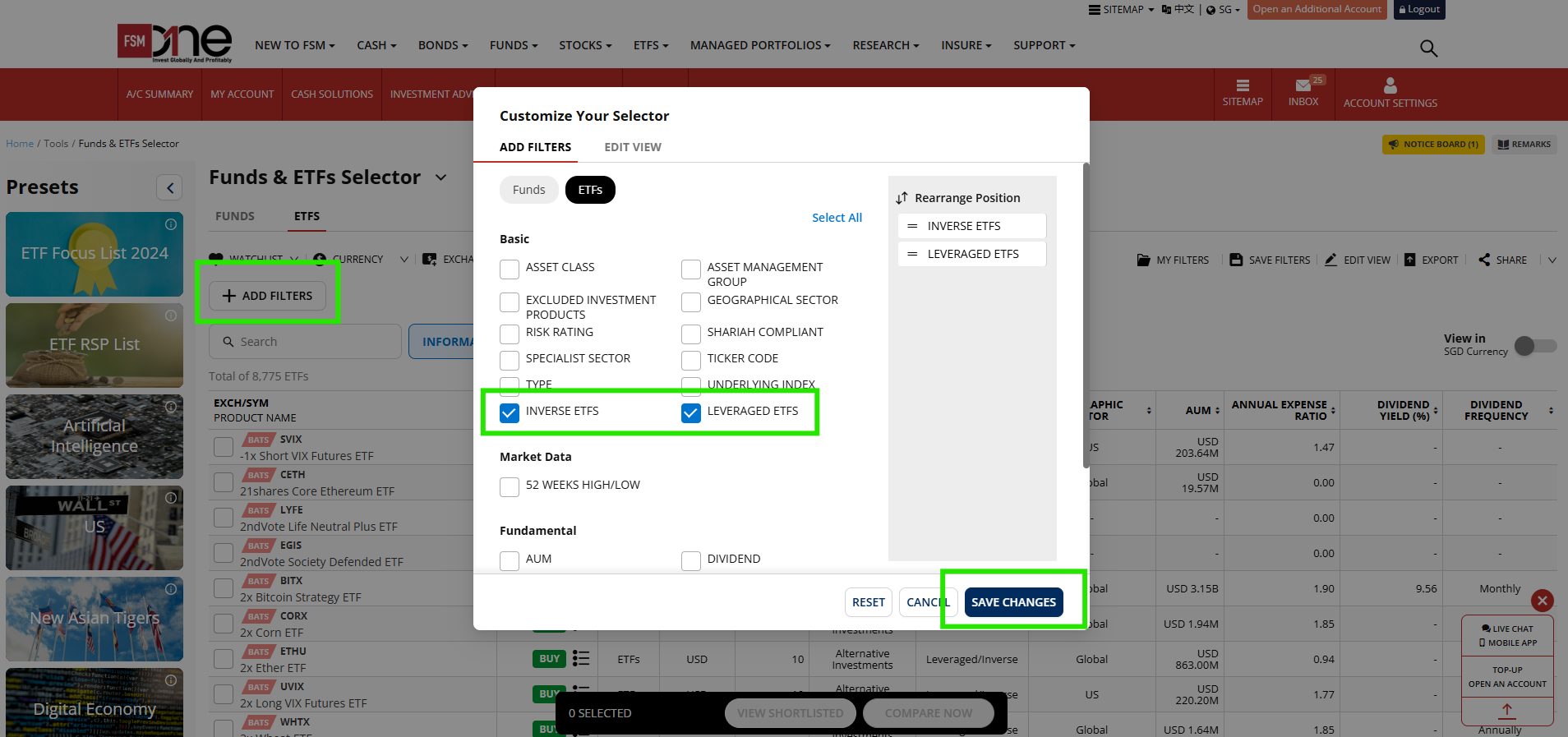
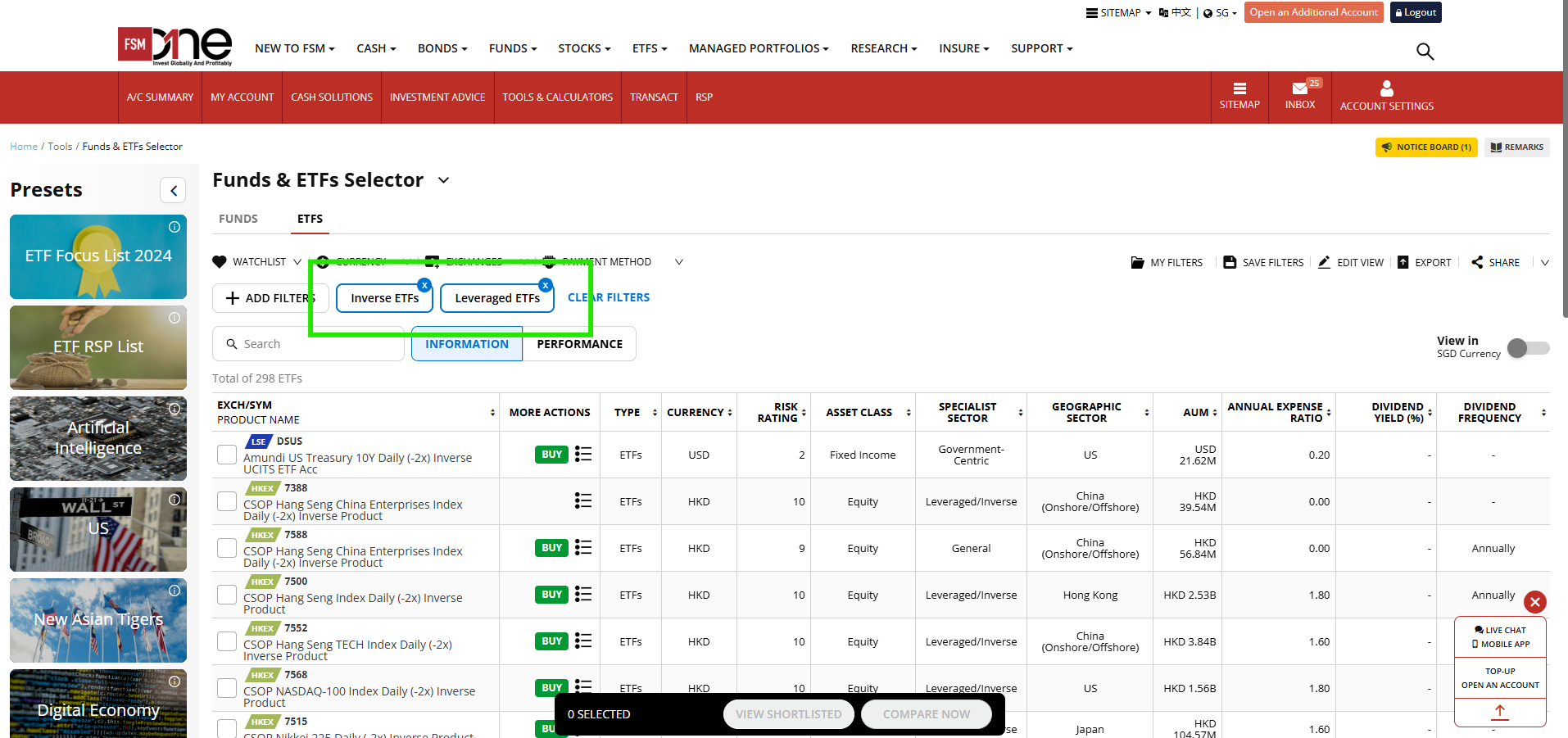
Here are some of the popular stocks and ETFs with their leveraged and inverse counterparts:
|
Name |
Stock/ETF |
Leveraged ETF |
Inverse ETF |
|
Apple |
|||
|
Alphabet (Google) |
|||
|
Meta |
|||
|
Amazon |
|||
|
NVIDIA |
|||
|
Tesla |
|||
|
Microsoft |
|||
|
Magnificent 7 |
|||
|
Semiconductor |
Conclusion
While leveraged and inverse ETFs can be valuable tools for investors looking to take advantage of short-term market movements, they are generally not recommended for long-term portfolios due to their inherent risks and complexity. These ETFs are designed for short-term trading and are subject to daily rebalancing, which can lead to significant tracking errors over extended periods. In the long run, the compounding of daily returns may result in performance that diverges from the intended leveraged or inverse exposure, especially in volatile or sideways markets.
For a long-term, holistic investing goal, we recommend that investors stick with core ETFs and unit trusts. Click on the respective link if you wish to find out more on our ETF Focus List and Recommended Funds.

' d='M0 0h300v57H0z'/%3e%3c/svg%3e "sgFsmLogoEnIcon")


'%3e%3cpath fill='%23fff' d='M0 0h21.6v21.6H0z'/%3e%3cg data-name='141-singapore'%3e%3cpath data-name='Rectangle 6502' fill='%23f0f0f0' d='M0 0h22v22H0z'/%3e%3cpath data-name='Rectangle 6503' fill='%23d80027' d='M0 0h22v10H0z'/%3e%3cg data-name='Group 21092' fill='%23f0f0f0'%3e%3cpath data-name='Path 14455' d='M2.917 5.365A3.128 3.128 0 015.374 2.31a3.128 3.128 0 100 6.11 3.128 3.128 0 01-2.457-3.055z'/%3e%3cpath data-name='Path 14456' d='M6.939 2.46l.222.683h.718l-.581.422.222.683-.581-.422-.581.422.222-.683-.581-.422h.718z'/%3e%3cpath data-name='Path 14457' d='M5.193 3.801l.222.683h.718l-.581.422.222.683-.581-.422-.581.422.222-.683-.581-.422h.718z'/%3e%3cpath data-name='Path 14458' d='M8.68 3.801l.222.683h.718l-.581.422.222.683-.581-.422-.581.422.222-.683-.581-.422h.718z'/%3e%3cpath data-name='Path 14459' d='M8.01 5.811l.222.683h.718l-.581.422.222.683-.581-.422-.581.422.222-.683-.581-.422h.718z'/%3e%3cpath data-name='Path 14460' d='M5.863 5.811l.222.683h.718l-.581.422.222.683-.581-.422-.581.422.222-.683-.581-.422h.718z'/%3e%3c/g%3e%3c/g%3e%3c/g%3e%3c/svg%3e "singaporeIcon")


