


' fill='%23fff' stroke='%23707070' d='M0 0h21.6v21.6H0z'/%3e%3c/clipPath%3e%3cclipPath id='c'%3e%3cpath data-name='Rectangle 6531' transform='translate(-6319 -2048)' fill='%23fff' stroke='%23707070' d='M0 0h43.2v21.6H0z'/%3e%3c/clipPath%3e%3cclipPath id='a'%3e%3cpath d='M0 0h21.6v21.6H0z'/%3e%3c/clipPath%3e%3c/defs%3e%3cg data-name='Malaysia -Square' clip-path='url(%23a)'%3e%3cpath fill='%23fff' d='M0 0h21.6v21.6H0z'/%3e%3cg data-name='Mask Group 325' transform='translate(6348 2048)' clip-path='url(%23b)'%3e%3cg data-name='Mask Group 324' transform='translate(-35)' clip-path='url(%23c)'%3e%3cg data-name='Group 21195'%3e%3cpath data-name='Path 14718' d='M-6319-2048h43.2v21.6h-43.2z' fill='%23fff'/%3e%3cpath data-name='Path 14719' d='M-6317.457-2047.229h41.657m0 3.086h-41.657m0 3.086h41.657m0 3.086h-41.657' fill='none' stroke='%23c00' stroke-width='1.543'/%3e%3cpath data-name='Path 14720' d='M-6319-2048h21.6v13.114h-21.6z' fill='%23006'/%3e%3cpath data-name='Path 14721' d='M-6319-2034.886h43.2m0 3.086h-43.2m0 3.086h43.2' fill='none' stroke='%23c00' stroke-width='1.543'/%3e%3c/g%3e%3cpath data-name='Path 14722' d='M-6302.5-2045.686l.344 2.353 1.331-1.967-.714 2.269 2.054-1.2-1.626 1.731 2.372-.19-2.218.858 2.218.858-2.372-.19 1.626 1.736-2.054-1.2.714 2.269-1.331-1.97-.344 2.358-.344-2.353-1.331 1.97.714-2.269-2.054 1.2 1.626-1.737-2.372.19 2.218-.858-2.218-.859 2.372.19-1.626-1.736 2.054 1.2-.714-2.267 1.331 1.97zm-1.929.1a4.114 4.114 0 100 7.521 4.629 4.629 0 110-7.521z' fill='%23fc0'/%3e%3c/g%3e%3c/g%3e%3c/g%3e%3c/svg%3e "malaysiaIcon")
'%3e%3cpath fill='%23fff' d='M0 0h21.6v21.6H0z'/%3e%3cg data-name='067-hong-kong'%3e%3cpath data-name='Rectangle 6488' fill='%23d80027' d='M0 0h22v22H0z'/%3e%3cg data-name='Group 21086' fill='%23f0f0f0'%3e%3cpath data-name='Path 14432' d='M11.911 8.264c-.248 1.032-.689.835-.905 1.735a2.373 2.373 0 011.109-4.614c-.429 1.803.018 1.956-.204 2.879z'/%3e%3cpath data-name='Path 14433' d='M8.606 9.029c.9.555.581.913 1.37 1.4a2.373 2.373 0 01-4.045-2.481c1.577.964 1.866.586 2.675 1.081z'/%3e%3cpath data-name='Path 14434' d='M8.311 12.409c.807-.689 1.048-.271 1.752-.871a2.373 2.373 0 11-3.609 3.081c1.408-1.202 1.136-1.594 1.857-2.21z'/%3e%3cpath data-name='Path 14435' d='M11.435 13.734c-.406-.98.066-1.08-.287-1.935a2.373 2.373 0 111.815 4.385c-.708-1.71-1.165-1.573-1.528-2.45z'/%3e%3cpath data-name='Path 14436' d='M13.66 11.173c-1.058.083-1.007-.4-1.929-.325a2.373 2.373 0 114.731-.371c-1.846.145-1.856.621-2.802.696z'/%3e%3c/g%3e%3c/g%3e%3c/g%3e%3c/svg%3e "hongKongIcon")


• Microsoft has delivered growth over the past year and has been more resilient as compared to the other Big Tech names in 1H22. The reason for that is because Microsoft is in the cloud computing business.
• Going forward, we expect Microsoft to see relatively resilient demand in the near term. Long term, we believe Microsoft is poised to capture the growth from corporate digitalisation, as well as enjoy margin expansion.
• Two key weapons that give Microsoft its competitive edge – its comprehensive suite of cloud computing solutions and strong brand equity with a focus on large corporates.
• Our target price of USD 315 for Microsoft (NASDAQ:MSFT) translates to an upside potential of approximately 40%.
As markets tumble and a sea of red becomes almost a daily affair, we look for strong companies with sustainable business models to invest in. Companies that can weather the macroeconomic storm in the near-term, and also possess long-term growth potential. And we think Microsoft (NASDAQ: MSFT) is one such stock.
Microsoft’s competitive edge lies in its comprehensive suite of cloud computing solutions – infrastructure-as-a-service (IaaS), platform-as-a-service (PaaS), and software-as-a-service (SaaS)), and its strong relationships with corporates. In turn, that is expected to poise the company to see demand resilience in the near-term, and long-term growth with margin expansion potential.
Here in this article we lay out the investment case for Microsoft.
Microsoft continues to see growth and market share gains
Like many other tech companies, Microsoft (NASDAQ: MSFT) has been a beneficiary of the digitalisation acceleration as covid19 plagued the world in the last two years.
Revenue grew more than 20% year-on-year (YoY) in 2021 and has continued to grow double digits in 1H22. Operating margins have also expanded across the past three years, and remains relatively stable in 1H22 albeit a slight decline (Figure 1).
Figure 1: Microsoft’s revenue growth continues to be healthy

Microsoft has demonstrated resilience although the general covid19 driven digitalisation boom fades and as the macroeconomic headwinds grow. Revenue growth has not seen as huge a decline as compared to other Big Tech players (Figure 2).
Figure 2: Big Tech companies have faced headwinds in 1H22, but Microsoft’s earnings results demonstrate resilience

The reason for Microsoft’s relatively more stable revenue growth, as compared to the other Big Tech players, can mostly be attributed to its business revenue exposure, where the main bulk of Microsoft’s revenue comes from its cloud computing business, which is driven by the more resilient digitalisation of workloads.
Related article: Digital Economy: Corporate’s digital transformation are the next earnings growth driver
Additionally, among the top three cloud computing companies, Microsoft has the largest exposure to the cloud business (Figure 3). Whereas, the majority of Amazon’s revenue comes from the e-commerce division, and for Google, it is from digital advertising. Both of which have been negatively impacted as the economy slows down, resulting in slowing consumption and declining advertising budgets.
Figure 3: Among the top three cloud players, Microsoft has the largest exposure to the cloud computing business

Furthermore, within the IaaS segment, Microsoft has gained market share in the past year, which demonstrates its resilience (Figure 4).
Figure 4: Among the top three cloud players, Microsoft Azure gained the most market share across the past year

All in all, Microsoft has done better than the other Big Tech companies, as the cloud computing business has continued to grow while the other digital economy segments have slowed.
Two key weapons – business mix and brand equity
Before diving into the reasons on our positive outlook for Microsoft, we examine the competitive edge of Microsoft that underpins the investment case – its business mix (Figure 5) and strong brand equity.
Figure 5: Microsoft’s main business is in cloud computing

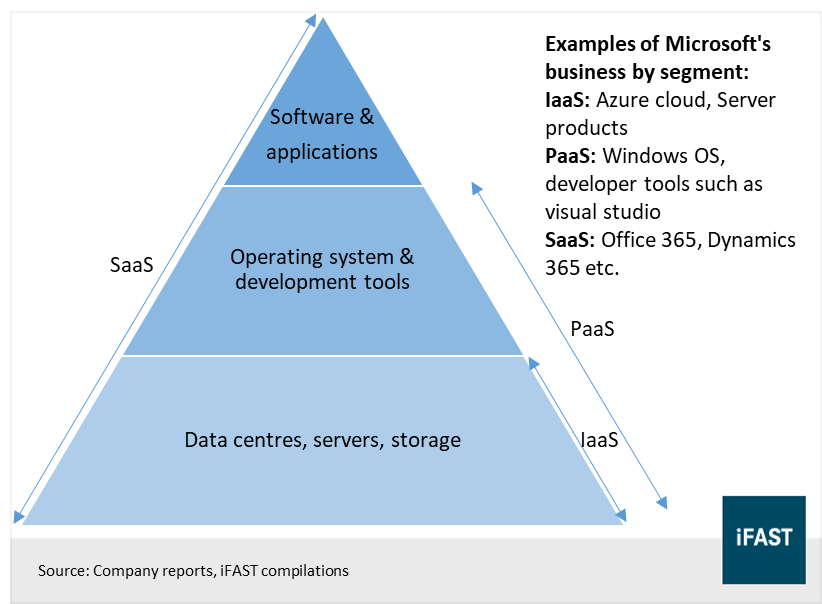
Firstly, unlike other cloud computing players, Microsoft offers a comprehensive suite of cloud computing solutions, from IaaS to SaaS (Figure 6). Whereas competitors like Salesforce (NYSE: CRM) and SAP (NYSE: SAP), are just focused on the SaaS business, and Amazon (NASDAQ: AMZN) and Google (NASDAQ: GOOGL) remain mostly experienced in the IaaS and PaaS business.
The one-stop cloud computing solution Microsoft offers is a competitive edge as it provides customers convenience and ease of integration, rather than needing to onboard a long-list of different vendors. To illustrate, if a company is already using Microsoft Office (Office 365 suite – Word, PowerPoint, Excel), the corporate relationship has been formed and would make it simpler to onboard other solutions by Microsoft.
Figure 6: Microsoft’s suite of products and services
Secondly, Microsoft’s demand is mostly driven by corporates, with a tilt towards larger businesses. While Amazon cloud has a higher exposure to small-medium businesses (SMB).
Additionally, Microsoft’s longstanding relationship with corporates across the globe gives them a strong edge. Compared to Amazon or Google, Microsoft has been a brand corporates use and trust. Microsoft office has been around since 1989, and Windows Operating System has been around since 1985. Both have been a core backbone to the everyday running of corporates, and Microsoft continues to focus its offerings for corporates.
Hence, with the comprehensive suite of solutions and strong brand equity with a focus on large corporates, we believe that Microsoft is better capitalised to capture the growth from the digitalisation of workloads, as well as enjoy sustainable margins with expansion potential, which we detail in the following two sections.
Resilience in the near-term as corporates digitalise
Given Microsoft’s business mix, Microsoft is likely to see resilience in the near-term, as the trend of the digitalisation of workloads is expected to continue even amid the macroeconomic downturn.
This is because shifting workloads to the cloud helps businesses save costs, improve business agility and innovation, which strengthens a company’s ability to tide through economic downturns. According to an Accenture global survey, out of the 4,000 global business and IT leaders, about 65% of respondents saw up to 10% in cost savings, on average, from moving their workloads onto the cloud.
Hence, the value proposition of digitalising workloads by shifting to the cloud remains attractive amid an economic downturn, which should drive the continued IT spend by corporates to digitalise their operations.
Moreover, what adds to our confidence is the fact that in 2Q22, Microsoft still sees a healthy pipeline of demand. In 2Q22, Microsoft (NASDAQ: MSFT) saw strong bookings growth and closed the biggest number of large Azure cloud deals (valued over USD 100 million), with even one USD 1 billion deal.
The strong bookings and long-term contracts further reiterate that Microsoft is a trusted vendor by corporates. Management also gave positive guidance of double-digit revenue growth for the next 12 months, as they expect companies to continue their cloud transition even amid an economic downturn.
Therefore, Microsoft is likely to see resilient demand in both its intelligent cloud and productivity & business processes divisions, which offers the full spectrum of cloud computing solutions.
Related article: Where to invest? Cloud computing is our pick
Microsoft possesses sustainable margins with room for expansion
Apart from liking Microsoft for its demand resilience, a key to our investment case lies in that the business has sustainable margins with room for expansion in the long-term. Microsoft has seen margins improve over the past few years, and is at much more attractive levels than its peers (Figure 7).
Figure 7: Microsoft cloud operating margins are better than many of its cloud competitors

Additionally, Microsoft is already a high-margin business, with margins highest in the productivity & business processes division (Figure 8).
Figure 8: Operating margins of Microsoft by business segment

Going forward, we expect margin expansion to continue, for the reasons laid out below.
1) Its ecosystem of cloud computing solutions
A key pillar for Microsoft’s margin expansion potential lies in its business mix. Microsoft’s comprehensive suite of cloud computing solutions across IaaS and SaaS drives synergies and economies of scale.
Having an expertise across IaaS and SaaS allows Microsoft to cross-sell multiple solutions to the same customer. This reduces customer acquisition, sales and servicing costs, which remains as a huge weight on margins for SaaS companies. (Figure 9)
Furthermore, customers grow in familiarity with the provider, hence increasing customer stickiness and retention, which is evident in that Microsoft has secured a significant number of large long-term contracts.
Figure 9: Customer acquisition costs remain a huge expense for SaaS companies

Operational efficiencies are also another upside for Microsoft, as its cloud solutions run on the same technology stack, and the same backbone cloud infrastructure Azure. With more solutions based on the same Capex-intensive cloud infrastructure, economies of scale can be achieved which boosts margins.
2) Strong legacy relationship with corporates and partner distributors
Another factor that keeps Microsoft’s sales and marketing expenses low is its brand equity. As a trusted brand, we think Microsoft is well positioned to capture the growth from the digitalisation of workloads and enjoy economies of scale. Furthermore, Microsoft has a greater exposure to large corporates, who tend to sign larger business deals, which benefits margins, as compared to SMBs.
Microsoft also adopts a distribution model, where it engages with its partners to distribute its products and services. The relationship fostered with its partners over the years has been strong and benefits Microsoft in terms of its customer reach, and also reduces the company’s sales and servicing costs.
3) Growing market with strong demand indicates margin upside
Finally, the cloud adoption rates are still low, with only a total of 30% of enterprise workloads that have shifted to the cloud. Thus, in a growing market, and with demand for cloud infrastructure outpacing the supply, margins are less likely to shrink.
In summary, given the comprehensive cloud computing solutions and exposure to large corporates, Microsoft should enjoy margin expansion in the long-term. (Figure 10)
Figure 10: Margins for Microsoft expected to expand

Key investment risks
Rising electricity prices – data centres consume a lot of energy, accounting for 1% of the global electricity use. With energy-driven inflation, rising electricity prices pose a risk to the company’s profits. However, Microsoft has been shifting towards renewable energy and innovating to reduce its overall electricity consumption.
Supply chain issues – Microsoft’s PC sales slowdown risks further downside, as the semiconductor supply and Chinese supply chain disruptions persist. However, in the case of easing covid19 restrictions in China, it would alleviate the supply chain issues, and stimulate demand recovery.
Global recession – in the case of a recession, Microsoft’s customers could go bust. However, as Microsoft has larger exposure to existing large corporates rather than SMBs and startups, these customers are likely more resilient and hence lower risks.
A resilient business with attractive margins
Microsoft has been a longstanding trusted company with a strong brand. In the near-term, we expect Microsoft (NASDAQ: MSFT) to see resilience, with possible positive surprises, which could drive share price gains. Long-term, Microsoft is attractive for its growth and margin expansion potential as digitalisation of corporates accelerates.
All in all, Microsoft is a good buy, but we caution that investors should expect volatility in the near term as macroeconomic headwinds could weigh on the share price.
Table 1: Earnings resilience in the near-term
|
2021 |
2022E |
2023E |
2024E |
|
|
EPS |
9.40 |
9.17 |
10.26 |
12.12 |
|
Earnings Growth |
40.0% |
-2.4% |
11.8% |
18.1% |
|
PE Ratio |
24.32 |
24.91 |
22.28 |
18.86 |
|
Upside Potential |
- |
- |
- |
37.8% |
|
Source: Bloomberg Finance L.P. Data as of 17 October 2022 |
||||
Our target price of USD 315 for Microsoft (NYSE:MSFT) is based on a fair PE multiple of 26X applied to its 2022 estimated earnings. This translates to an upside potential of approximately 40% based on its last traded price of USD 228.56 as of 14 October 2022.
Declaration:
For specific disclosure, at the time of publication of this report, IFPL (via its connected and associated entities) and the analyst who produced this report hold a NIL position in the abovementioned securities.

' d='M0 0h300v57H0z'/%3e%3c/svg%3e "sgFsmLogoEnIcon")


'%3e%3cpath fill='%23fff' d='M0 0h21.6v21.6H0z'/%3e%3cg data-name='141-singapore'%3e%3cpath data-name='Rectangle 6502' fill='%23f0f0f0' d='M0 0h22v22H0z'/%3e%3cpath data-name='Rectangle 6503' fill='%23d80027' d='M0 0h22v10H0z'/%3e%3cg data-name='Group 21092' fill='%23f0f0f0'%3e%3cpath data-name='Path 14455' d='M2.917 5.365A3.128 3.128 0 015.374 2.31a3.128 3.128 0 100 6.11 3.128 3.128 0 01-2.457-3.055z'/%3e%3cpath data-name='Path 14456' d='M6.939 2.46l.222.683h.718l-.581.422.222.683-.581-.422-.581.422.222-.683-.581-.422h.718z'/%3e%3cpath data-name='Path 14457' d='M5.193 3.801l.222.683h.718l-.581.422.222.683-.581-.422-.581.422.222-.683-.581-.422h.718z'/%3e%3cpath data-name='Path 14458' d='M8.68 3.801l.222.683h.718l-.581.422.222.683-.581-.422-.581.422.222-.683-.581-.422h.718z'/%3e%3cpath data-name='Path 14459' d='M8.01 5.811l.222.683h.718l-.581.422.222.683-.581-.422-.581.422.222-.683-.581-.422h.718z'/%3e%3cpath data-name='Path 14460' d='M5.863 5.811l.222.683h.718l-.581.422.222.683-.581-.422-.581.422.222-.683-.581-.422h.718z'/%3e%3c/g%3e%3c/g%3e%3c/g%3e%3c/svg%3e "singaporeIcon")


