


' fill='%23fff' stroke='%23707070' d='M0 0h21.6v21.6H0z'/%3e%3c/clipPath%3e%3cclipPath id='c'%3e%3cpath data-name='Rectangle 6531' transform='translate(-6319 -2048)' fill='%23fff' stroke='%23707070' d='M0 0h43.2v21.6H0z'/%3e%3c/clipPath%3e%3cclipPath id='a'%3e%3cpath d='M0 0h21.6v21.6H0z'/%3e%3c/clipPath%3e%3c/defs%3e%3cg data-name='Malaysia -Square' clip-path='url(%23a)'%3e%3cpath fill='%23fff' d='M0 0h21.6v21.6H0z'/%3e%3cg data-name='Mask Group 325' transform='translate(6348 2048)' clip-path='url(%23b)'%3e%3cg data-name='Mask Group 324' transform='translate(-35)' clip-path='url(%23c)'%3e%3cg data-name='Group 21195'%3e%3cpath data-name='Path 14718' d='M-6319-2048h43.2v21.6h-43.2z' fill='%23fff'/%3e%3cpath data-name='Path 14719' d='M-6317.457-2047.229h41.657m0 3.086h-41.657m0 3.086h41.657m0 3.086h-41.657' fill='none' stroke='%23c00' stroke-width='1.543'/%3e%3cpath data-name='Path 14720' d='M-6319-2048h21.6v13.114h-21.6z' fill='%23006'/%3e%3cpath data-name='Path 14721' d='M-6319-2034.886h43.2m0 3.086h-43.2m0 3.086h43.2' fill='none' stroke='%23c00' stroke-width='1.543'/%3e%3c/g%3e%3cpath data-name='Path 14722' d='M-6302.5-2045.686l.344 2.353 1.331-1.967-.714 2.269 2.054-1.2-1.626 1.731 2.372-.19-2.218.858 2.218.858-2.372-.19 1.626 1.736-2.054-1.2.714 2.269-1.331-1.97-.344 2.358-.344-2.353-1.331 1.97.714-2.269-2.054 1.2 1.626-1.737-2.372.19 2.218-.858-2.218-.859 2.372.19-1.626-1.736 2.054 1.2-.714-2.267 1.331 1.97zm-1.929.1a4.114 4.114 0 100 7.521 4.629 4.629 0 110-7.521z' fill='%23fc0'/%3e%3c/g%3e%3c/g%3e%3c/g%3e%3c/svg%3e "malaysiaIcon")
'%3e%3cpath fill='%23fff' d='M0 0h21.6v21.6H0z'/%3e%3cg data-name='067-hong-kong'%3e%3cpath data-name='Rectangle 6488' fill='%23d80027' d='M0 0h22v22H0z'/%3e%3cg data-name='Group 21086' fill='%23f0f0f0'%3e%3cpath data-name='Path 14432' d='M11.911 8.264c-.248 1.032-.689.835-.905 1.735a2.373 2.373 0 011.109-4.614c-.429 1.803.018 1.956-.204 2.879z'/%3e%3cpath data-name='Path 14433' d='M8.606 9.029c.9.555.581.913 1.37 1.4a2.373 2.373 0 01-4.045-2.481c1.577.964 1.866.586 2.675 1.081z'/%3e%3cpath data-name='Path 14434' d='M8.311 12.409c.807-.689 1.048-.271 1.752-.871a2.373 2.373 0 11-3.609 3.081c1.408-1.202 1.136-1.594 1.857-2.21z'/%3e%3cpath data-name='Path 14435' d='M11.435 13.734c-.406-.98.066-1.08-.287-1.935a2.373 2.373 0 111.815 4.385c-.708-1.71-1.165-1.573-1.528-2.45z'/%3e%3cpath data-name='Path 14436' d='M13.66 11.173c-1.058.083-1.007-.4-1.929-.325a2.373 2.373 0 114.731-.371c-1.846.145-1.856.621-2.802.696z'/%3e%3c/g%3e%3c/g%3e%3c/g%3e%3c/svg%3e "hongKongIcon")


• Over the past quarters, the cloud computing industry has consistently outperformed the other digital economy segments, delivering revenue growth in the double-digits, demonstrating its resilience.
• In the near term, we think that this resilient growth is likely to continue, even amid an economic downturn, as demand remains healthy and because of the economic benefits of cloud computing.
• Long-term, the outlook is also good, as cloud computing is a foundation of many other technologies that are experiencing rising adoption and growth.
• Overall, we are positive on the cloud computing industry, with a preference for the infrastructure-as-a-service (IaaS) segment, to which the First Trust Cloud Computing ETF has a larger exposure to.
• Our target price for the First Trust Cloud Computing ETF (NASDAQ: SKYY) is USD 85, based on 2024 projected EPS. This translates to an upside potential of 27.1% based on its closing price of USD 66.84 as of 7 September 2022.
Cloud computing technology, a bedrock for the digital economy, has seen sturdy growth across the past few years (Figure 1). According to Gartner research, the global cloud computing market grew over 20% in 2021 (Figure 1), and in particular, the infrastructure-as-a-service (IaaS) segment outperformed, growing over 40% in 2021, which we wrote about in 2019.
In 2021, according to Gartner research, the breakdown of the global cloud computing market by segment stands at 22% from IaaS, 21% from PaaS, 37% from SaaS, and 20% from other services.
Figure 1: Global cloud computing market – cloud infrastructure-as-a-service (IaaS), platform-as-a-service (PaaS), and software-as-a-service (SaaS) – expected to continue growing

In this article, we review how the cloud computing industry has performed and put forth our case on why the cloud computing industry is likely to see resilience and growth, particularly in the IaaS/PaaS segment where Amazon (NASDAQ: AMZN) the first-mover remains as the leader. (Figure 2)
Figure 2: Market share in the IaaS/PaaS segment

Resilient fundamentals among the IaaS/PaaS leaders
Over the past quarters, the IaaS/PaaS players have consistently outperformed the other digital economy segments, delivering growth in the double-digits, demonstrating its resilience. The IaaS/PaaS players have sustained its growth post the covid19 digitalisation boom, while other segments such as digital advertising and e-commerce have seen a slowdown. (Figure 3)
Figure 3: The cloud computing segment posts resilient growth while the others see a slowdown

The resilience seen in the cloud computing segment has been a result of businesses continuing to move their workloads onto the cloud and digitalise their operations. While, on the other hand, consumer-driven businesses (such as iPhone sales, e-commerce, and digital advertising) saw a slowdown, as the weak economic environment remains an overhang.
This is simply because cloud computing is a useful technology that provides businesses with cost savings and enables companies to remain competitive in this day and age. Hence, this has driven the continued shift onto the cloud, even amid an economic downturn.
Related article: Digital economy: Is it time to get back into tech stocks?
Margins have also seen an improvement, as the IaaS/PaaS players reap the benefits of economies of scale. The relatively steady level of margins through 2022 also reflects that inflationary and macroeconomic pressures are manageable. (Figure 4)
Figure 4: Margin improvement was seen across the IaaS/PaaS leaders

The cloud computing segment has performed better than the other digital economy segments, making up a larger pie of the business for Big Tech (Figure 5), and we remain confident in its ability to sustain this growth.
Figure 5: The cloud computing segment operating income contribution has grown

Cloud computing industry still expected to grow even in an economic downturn
The first reason for our confidence is that the IaaS/PaaS industry leaders continue to see a healthy pipeline of demand that exceeds the current supply.
In 2Q22, Microsoft (NASDAQ: MSFT) saw strong bookings growth and closed the biggest number of large Azure cloud deals (over USD 100 million), with even one USD 1 billion deal. Management also gave positive guidance of double-digit revenue and profit growth for the next 12 months, as they expect companies to continue their cloud transition even amid an economic downturn, as cloud computing helps in improving efficiency and overall cost management. Similarly, the pipeline at Amazon cloud (AWS) remains healthy, with customers in queue, measured by the order backlog, growing at 65% YoY and 13% QoQ in 2Q22.
Secondly, since it is because of an economic value that drives businesses to shift to the cloud, demand will remain relatively resilient despite an economic downturn.
According to an Accenture global survey, out of the 4,000 global business and IT leaders, about 65% of respondents saw up to 10% in cost savings, on average, from moving their workloads onto the cloud. Since shifting to the cloud leads to cost savings, it is all the more that businesses will be motivated to shift to the cloud to benefit from savings which will help companies tide the economic downturn.
On top of cost savings, Accenture’s research shows that businesses that take the cloud transition a step further benefit from substantial gains (both monetary and non-monetary). These gains arise from how the cloud acts as a launchpad for innovation to improve operations, products, and services. The research also showed that such companies are better poised to withstand business shocks.
Hence, given the strong bookings and the economic benefits of the cloud, we think that the demand for cloud computing services will remain resilient even amid an economic downturn.
Next, we expect margins to remain stable due to the benefits of economies of scale and high switching costs which result in customers remaining sticky. Firstly, economies of scale are enjoyed by the players as the rise of cloud adoption enables higher utilisation of their data center capacity.
Secondly, barriers to switching are high due to the lengthy and complicated process of sourcing, approval, and firm-wide implementation of a new cloud IaaS/PaaS system. Moreover, even after switching IaaS/PaaS providers, software integration would also have to undergo changes.
Finally, the cloud adoption rates are still low, with only a total of 30% of enterprise workloads that have shifted to the cloud. Thus, in a growing market, and with demand for cloud infrastructure outpacing the supply, margins are unlikely to shrink.
All in all, we expect demand to be resilient even amid an economic downturn, and the margin outlook to remain stable.
Structural long-term drivers for the cloud computing industry
Long-term, the outlook is also good. Cloud computing is the foundation for other technologies, such as the internet-of-things, autonomous vehicles, factory automation, digital payments, and more. Hence, as these technologies gain traction, cloud computing would likewise grow. (Table 1)
Table 1: Examples of technologies that are built on the foundation of cloud computing
|
End application |
Detail |
Growth forecast |
|
Smart factories |
Cloud computing technology is required to run big data analysis, AI and IoT etc. in the monitoring and management of the robots and equipment. Some of the newer factories today are fully run by robots controlled by a human operator from another location. |
According to MarketsandMarkets, the global smart factory market is expected to grow at an 11% CAGR from 2021 till 2026 to USD 135 billion. |
|
Autonomous vehicles |
The vehicles require a constant internet connection and big data to navigate the streets, and these data and infrastructure will be based on cloud computing technology. |
According to IHS Markit, autonomous vehicle sales is expected to surpass 33 million units annually in 2040. |
|
Smart homes |
Smart homes are a series of connected by internet devices, enabling users to control house appliances from their mobile devices and remote locations, and the connections and data are stored on cloud computing technologies. |
According to Verified Market Research, the global smart home market size was valued at USD 119.95 billion in 2021 and is expected to reach USD 867.87 billion by 2030 (23.6% CAGR). |
|
Smart agriculture |
Drones and autonomous equipment are used to monitor and collect data on the crop and can be used to replace manual labour. Additionally, smart farming uses big data to improve crop yield and efficiency. Similar to smart factories, the equipment requires cloud computing technology to be monitored and managed. |
According to MarketsandMarkets, the smart agriculture market is expected to grow from USD 12.9 billion in 2021 to USD 20.8 billion by 2026; at a CAGR of 10.1%. |
Furthermore, not only will the cloud industry benefit from the growth of these existing technologies, but will also benefit from the development of new technologies that are built on the cloud foundation.
Related article: Cloud computing a green shoot among digital economy segments
Attractive entry point
All in all, the growth drivers for the cloud computing industry remain attractive, both in the near and long term. Share prices have also fallen, hence, we believe that it is an attractive entry point for investors in the cloud computing industry.
Among the various cloud computing segments, we are relatively more positive on the IaaS/PaaS segment over the SaaS segment because firstly, the growth is projected to be the strongest. According to Gartner estimates, the two-year CAGR growth rates are 31%, 25%, and 17% for the IaaS, PaaS and SaaS segments respectively till 2023.
Secondly, the IaaS segment has high barriers to entry due to the huge investment needed for the data centre infrastructure, and high switching barriers as mentioned above. Thus, is less exposed to price competition, as compared to the highly fragmented SaaS segment.
Therefore, the First Trust Cloud Computing ETF (NASDAQ: SKYY) is our recommended ETF as it gives investors greater exposure to the IaaS/PaaS segment. This ETF has an index methodology that assigns a score of three to IaaS, two to PaaS, and one to SaaS. Hence, it leads to a higher score and weight to IaaS/PaaS players.
Figure 6: The cloud computing segment held up better than the overall digital economy, but is still not unscathed
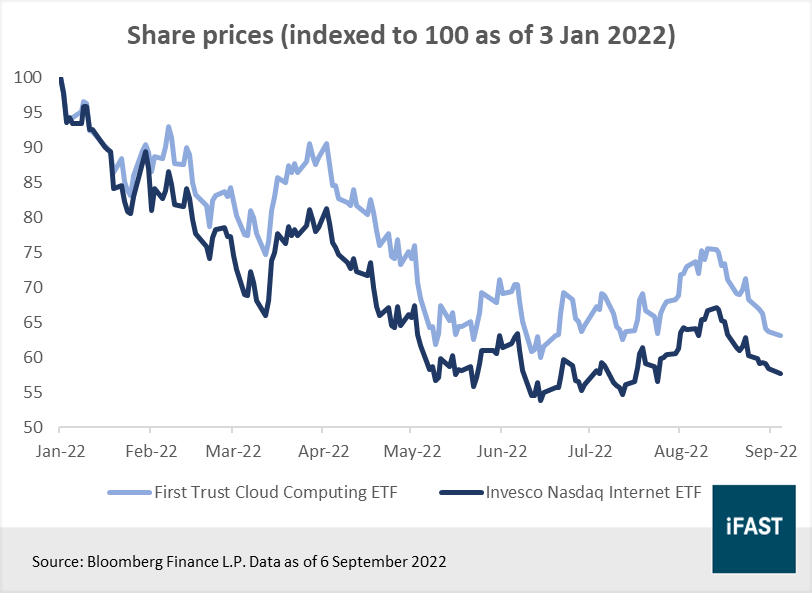
Assigning a fair PE of 33X to the estimated 2024 earnings per share, our target price for the First Trust Cloud Computing ETF (NASDAQ: SKYY) is USD 85. This translates to an upside potential of 27.1% based on its closing price of USD 66.84 as of 7 September 2022.
Table 2: First Trust Cloud Computing ETF to deliver earnings growth
|
2021 |
2022E |
2023E |
2024E |
|
|
EPS |
16.4 |
17.3 |
20.8 |
28.5 |
|
Earnings Growth |
13% |
5% |
20% |
37% |
|
PE Ratio |
45.1 |
42.8 |
35.7 |
26.0 |
|
Upside Potential |
- |
- |
- |
27.1% |
|
Source: iFAST estimates. Bloomberg Finance L.P. Data as of 8 Sep 2022 |
||||
Figure 7: In the long run, share prices are driven by earnings

Declaration:
For specific disclosure, at the time of publication of this report, IFPL (via its connected and associated entities) holds a NIL position in the abovementioned securities. The analyst who produced this report holds a position in Alibaba.

' d='M0 0h300v57H0z'/%3e%3c/svg%3e "sgFsmLogoEnIcon")


'%3e%3cpath fill='%23fff' d='M0 0h21.6v21.6H0z'/%3e%3cg data-name='141-singapore'%3e%3cpath data-name='Rectangle 6502' fill='%23f0f0f0' d='M0 0h22v22H0z'/%3e%3cpath data-name='Rectangle 6503' fill='%23d80027' d='M0 0h22v10H0z'/%3e%3cg data-name='Group 21092' fill='%23f0f0f0'%3e%3cpath data-name='Path 14455' d='M2.917 5.365A3.128 3.128 0 015.374 2.31a3.128 3.128 0 100 6.11 3.128 3.128 0 01-2.457-3.055z'/%3e%3cpath data-name='Path 14456' d='M6.939 2.46l.222.683h.718l-.581.422.222.683-.581-.422-.581.422.222-.683-.581-.422h.718z'/%3e%3cpath data-name='Path 14457' d='M5.193 3.801l.222.683h.718l-.581.422.222.683-.581-.422-.581.422.222-.683-.581-.422h.718z'/%3e%3cpath data-name='Path 14458' d='M8.68 3.801l.222.683h.718l-.581.422.222.683-.581-.422-.581.422.222-.683-.581-.422h.718z'/%3e%3cpath data-name='Path 14459' d='M8.01 5.811l.222.683h.718l-.581.422.222.683-.581-.422-.581.422.222-.683-.581-.422h.718z'/%3e%3cpath data-name='Path 14460' d='M5.863 5.811l.222.683h.718l-.581.422.222.683-.581-.422-.581.422.222-.683-.581-.422h.718z'/%3e%3c/g%3e%3c/g%3e%3c/g%3e%3c/svg%3e "singaporeIcon")


